

Will the self-sufficiency rate of new chemical materials reach 75% by 2025?
At present, China's new materials industry has formed a spatial layout of "gathering along the eastern coast and developing with distinctive features in the central and western regions". According to the new materials development plans and action plans announced by various provinces and cities across the country, the development goals for the 14th Five Year Plan period have also been gradually finalized.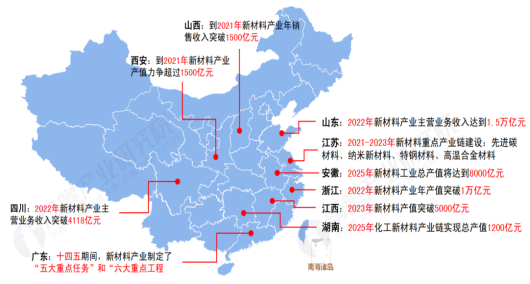
According to the "14th Five Year Plan Development Guidelines for the Petroleum and Chemical Industry" released by the China Petroleum and Chemical Industry Federation, by the end of the 14th Five Year Plan, China's self-sufficiency rate for new chemical materials should reach 75%, accounting for over 10% of the overall chemical industry.
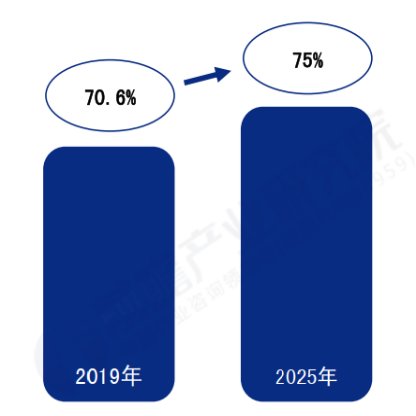
2019-2025年中国化工新材料自给率及预测
1. A billion level wind outlet
The billion dollar wind outlet mainly consists of cost-effective and high-performance electronic chemicals, including chips, sensors, and semiconductor electronics (electronic adhesives, photoresists, conductive materials, high-purity gases, solvents, etc.).
2. Trillion level wind outlet
The trillion level trend is mainly driven by new energy related materials, including solid-state batteries, fuel cells, hydrogen fuel cells, lithium batteries, solar photovoltaics, renewable energy, energy storage, wind energy, etc.
3. Other air vents
Other trends include biodegradable materials (beneficial for waste sorting, etc.) in the accelerated development stage, 3D printed new materials, structured materials, as well as lightweight and energy-saving materials.
The new type of elastomer is closely related to our industry. The editor will introduce several common new elastomer materials to you.
Acrylic based elastomers are produced by a combination of metallocene catalytic technology and solution polymerization process. They are unique semi crystalline copolymers of propylene and ethylene, with high elasticity, flexibility, and low-temperature impact resistance, especially excellent compatibility with PP.
Advantages of propylene based elastomers:
1. Acrylic based elastomers have the characteristics of good hand feel, high filling capacity, and excellent slip resistance. They have high filling capacity, with a filling amount of up to 100phr, while EVA filling capacity is generally 30phr. They have great advantages in reducing costs and making certain functional materials, such as flame retardant materials, which rely on filling to exert their performance;
2. It can be 100% recycled, and the foamed product will not have poor distribution of surface pores. However, if too much recycled material is added to EVA foam (usually 30phr), poor density distribution will occur;
3. Using VM for some relatively low hardness foaming processes is much easier to operate than EVA. If the hardness of EVA reaches 10 ° C, it is quite difficult, and SEBS is usually added to increase the softness, while VM is easy to achieve;
4. The improvement of impact strength brings about thinning opportunities, which can reduce material usage and lower costs;
5. Acrylic based elastomers have a lower melting temperature, which reduces processing temperature, and their higher flow rate increases processing speed.
Application of propylene based elastomers:
*Random polypropylene (RCP) is widely used in the field of food preservation boxes, but there is a common problem of insufficient low-temperature impact resistance.
The application of propylene based elastomers in polypropylene modification can improve the toughness of polypropylene. As a toughening agent in RCP, it can improve toughness while maintaining transparency, which helps reduce stress whitening in hinge structures;
*It can be used in non-woven fabrics, elastic films, polymer modification, etc., among which polymer modification performs well. Specific application cases include washing machine base plates, food container covers, humidifier water tanks, plastic stationery, sports water bottles, slippers, etc.
Properties and characteristics of vinyl elastomers:
1. POE has the dual characteristics of plastic and rubber, and has excellent comprehensive performance. Therefore, POE can be regarded as a bridge product between plastic and rubber.
2.Compared with EPDM, POE elastomer has the advantages of excellent weld line strength, good dispersion, high impact resistance with equal addition, and outstanding molding ability;
Compared with SBR, it has the advantages of good weather resistance, high transparency, low price, and low density;
Compared with EVA, EMA, and EEA, it has the advantages of low density, high transparency, good toughness, and good flexibility;
Compared with soft PVC, it has the characteristics of no need for special equipment, low corrosion to equipment, good thermoforming, good plasticity, low density, good low-temperature brittleness, and good economy.
2. POE elastomer, as a plastic toughening agent, can not only toughen and modify polyolefin plastics compatible with it, but also initiate grafting reactions with monomers such as maleic anhydride and glycidyl acrylate through peroxides. The resulting grafted products are widely used to toughen engineering plastics such as nylon and polyester.
Application of ethylene based elastomers:
*POE can pose a threat to materials such as rubber, flexible PVC, EPDM, EPR, EMA, EVA, TPV, SBC, and LDPE;
*Applied to different products, such as automotive baffles, flexible conduits, conveyor belts, printing rollers, sports shoes, wires and cables, automotive components, durable goods, extruded parts, molded parts, sealing materials, pipe fittings, and fabric coatings;
*It can also be used as a low-temperature impact modifier to improve the low-temperature impact resistance of PP, and can also be applied as a thermoplastic elastomer in the automotive field.
At present, traditional petrochemical oil and gas and basic chemical enterprises in China are making huge investments, with several clusters of investment projects worth billions of yuan, and there are already "countless" investment projects worth billions of yuan.
However, profits are rapidly declining, and the market prices of more and more basic chemical products are plummeting. Therefore, sufficient attention must be paid to the development of the new materials industry, otherwise, the real economy will not have strong competitiveness!
China's dependence on foreign natural rubber has exceeded 85%, and the research and development of related technologies for ethylene based and propylene based elastomers is urgently needed!